
Posts by Collection

portfolio

Neutral Atom Array Experiment

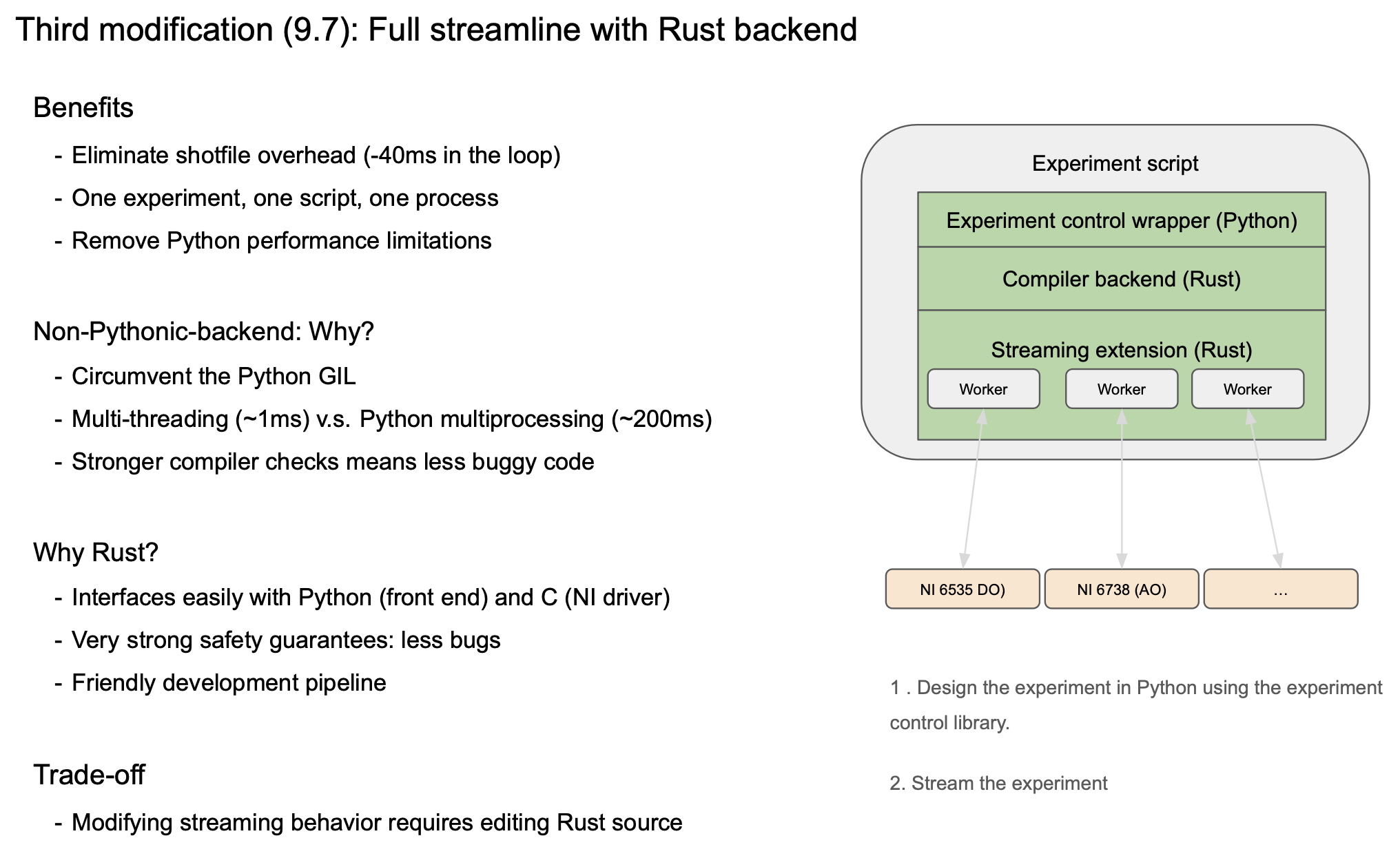
Since 2023, I have had the privilege of being part of the Semeghini lab, which aims to build a dual-species Rubidium-Ytterbium neutral atom array with continuous reloading. This experience has been instrumental in shaping my understanding of the connection between physics and computation; it helped me gain…

FreeAlgebra

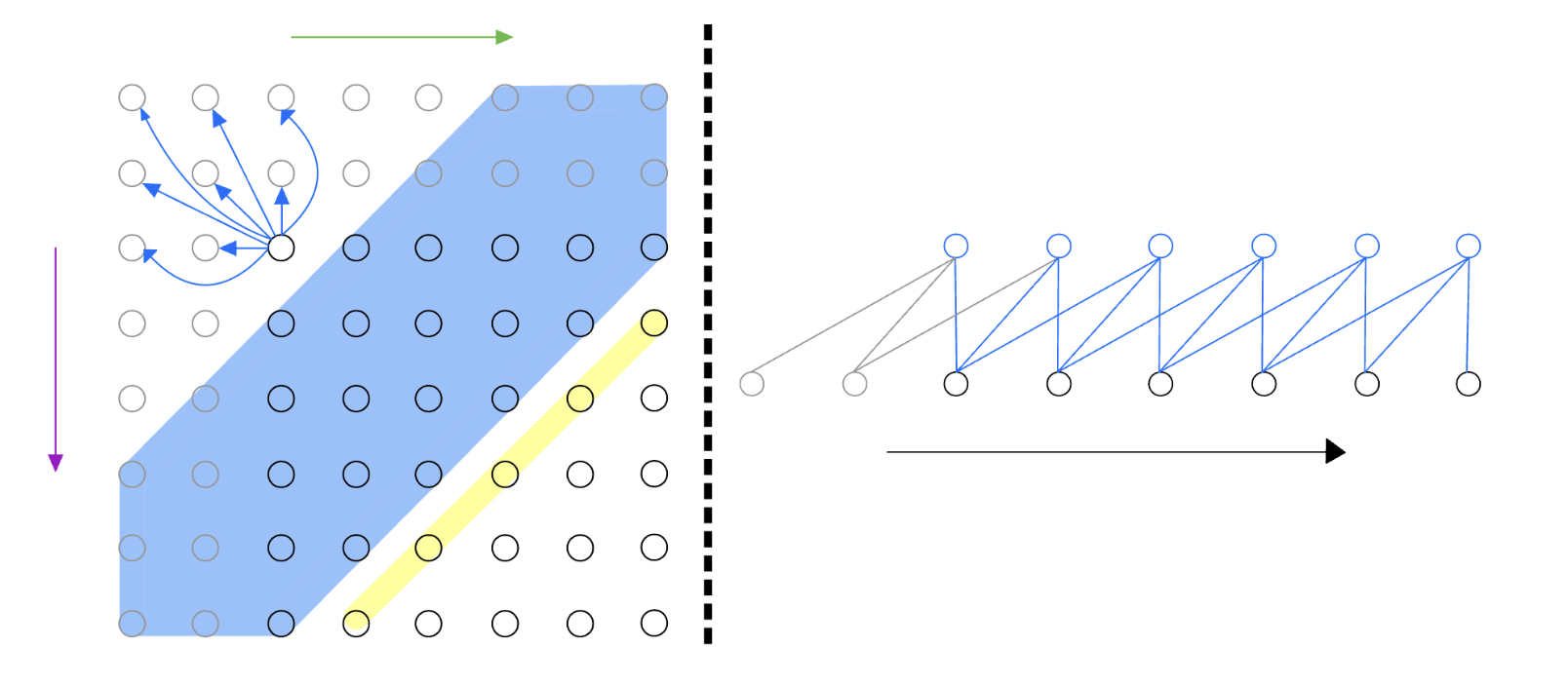
FreeAlgebra supports the differentiable manipulation of freely-generated algebras. It is an offshoot project of the theoretical research on fermionic Gaussian computation and a nice implementation practice for the theory of finitely-generated algebras.

Physics 151 (Fall 2023): KvN theory

The motivation for this final project is the adjoint problem of Hamiltonian mechanics: understanding how the evolution of a subsystem can be used to infer properties of the composite system. The goal is characterizing dynamical closures—the extension of subsystem dynamics into the Hamiltonian dynamics of a larger system. This problem is not solved by this project. However, the steps towards solving this problem provided insights into the relation between kinematics and dynamics, as well as the boundary between classical and quantum theories.

publications

Fermionic Gaussian Testing and Non-Gaussian Measures via Convolution

Published on arXiv, 2024

This work defines fermionic quantum convolution and demonstrates the unique entropy-invariance of fermionic Gaussian states under convolution. It demonstrates that many desirable classical statistical and information-theoretic properties of Gaussian states and convolution have counterparts in the fermionic quantum algebra. Click on the section title to see details.

Download Paper

Displaced Fermionic Gaussian States and their Classical Simulation

Published on Journal of Physics A: Mathematical and Theoretical, 2025

This work extends fermionic Gaussian theory by studying the displaced (nonzero mean) case, resulting in extended matchgate classical simulation, wider applicability of fermionic convolution, and a more generalized understanding of fermionic Gaussian computation beyond the constraint of parity super-selection. Click on the section title to see details.

Download Paper

talks

Theoretical Computer Science

Published:

Course notes for Harvard CS 121: Theoretical Computer Science (Fall 2022, Boaz Barak). Provides foundational knowledge in computability and complexity, as well as strong intuitions on computational models and fundamental limits of computation; my favorite computer science course at Harvard.

Quantum Computation

Published:

Course notes for MIT 8.3710(Fall 2022, Peter Shor), a introductory graduate course in quantum computation. Features the basics of quantum circuits, Grover and Shor’s algorithms, quantum channels and error-correction.

Basic Category Theory

Published:

Self-study notes for Tom Leinster’s Basic Category Theory Chapters 1-4, covering basic definitions, adjunction, representables, and universal constructions.

Algebra

Published:

Self-study notes on MacLane and Birkhoff’s Algebra. These notes cover topics roughly equivalent to a one-semester undergraduate course on group and ring theory.

Hyperbolic Geometry

Published:

Research notes including hyperbolic groups, Dehn algorithm, and Svarc-Milnor lemma. Part of an incomplete research project (suspended).

Classical Mechanics

Published:

Teaching assistant material of Harvard Physics 151: Mechanics (Fall 2024, Arthur Jaffe). It provides a mathematical perspective on the boundary between classical and quantum mechanics, with applications ranging from symmetry principles to field theory.

Classical Information Theory

Published:

Comprehensive course notes for MIT 6.370 Information Theory: from Coding to Learning, (Fall 2024, Yury Polyanskiy) This is a very fast-paced, graduate-level treatment of modern information theory.

Reinforcement Learning

Published:

Self-learning notes for reinforcement learning at introductory graduate level. Covers classical MDP theory as well as modern toolkits applicable to relaxed assumptions and learning-based methods.

teaching