3 Lebesgue measure
This section establishes the base case of the Lebesgue measure on \(\mathbb R^n\):
- Exterior measure: foundational properties of the exterior measure and interaction with rectangles.
- Lebesgue measure and Borel regularity: Borel sets, example of a non-measurable set, and approximation characterizations of measurable sets.
Key takeaways:
- The exterior measure is the natural outer-measure extension of rectangle volume that satisfies monotonicity and countable subadditivity.
- The Lebesgue measure is the Carathéodory restriction of the exterior measure.
- Rectangles are measurable (proposition 3.4), so Borel sets are measurable since they are freely-generated by rectangles.
- The exterior measure (rectangle cover infimum) is equivalent to open cover infimum, and on measurable sets equivalent to compact subset supremum.
- A set is measurable iff
Rectangles, exterior measure
Definition 3.1 (exterior measure) The exterior measure \(\mu_*(E)\) of any subset \(E\subset \mathbb R^n\) is \[ \mu_*(E) = \inf \sum_{j=1}^\infty |R_j| \] where the \(\inf\) is over all countable coverings of \(E\) by closed rectangles, the measure of a closed rectangle \(R_j = \prod_{j=1}^n [a_j, b_j]\) is \(|Q_j| = \prod_{j=1}^n (b_j - a_j)\).
Proposition 3.1 The exterior is an outer measure per definition 2.9.
- \(E_1\subset E_2\implies \mu_*(E_1)\leq \mu_*(E_2)\).
- \(E=\bigcup_{j=1}^\infty E_j\implies \mu_*(E)\leq \sum_{j=1}^\infty \mu_*(E_j)\).
Proof
To prove monotonicity, every covering of \(E_2\) by a countable set of cubes is also a covering of \(E_1\). For countable subadditivity, the main idea is to construct increasingly tight covers such that the countable union of these covers is still finitely tight. Assume the nontrivial case \(\mu_*(E_j)<\infty\). For every \(\epsilon>0\), we can construct for each \(j\) a covering \[ E_j\subset \bigcup_{k=1}^\infty R_{k, j}, \quad \sum_{k=1}^\infty |R_{k, j}| \leq \mu_*(E_j) + \dfrac{\epsilon}{2^j} \] The increasingly tight bound ensures that \[\begin{align} \mu_*(E) &\leq \sum_{j, k}|R_{k, j}| \leq \sum_{j=1}^\infty \mu_*(E_j) + \dfrac\epsilon {2^j} = \sum_{j=1}^\infty \mu_*(E_j)+\epsilon \end{align}\]Proposition 3.2 (equivalence with open cover infimum) Given \(E\subset \mathbb R^n\), \(\mu_*(E)=\inf \mu_*(\mathcal O)\), where \(\inf\) is over all open sets \(\mathcal O\) covering \(E\).
Proof
\(\mu_*(E)\leq \inf \mu_*(\mathcal O)\) holds by monotonicity. For the other direction, choose cubes \(R_j\) covering \(E\) with margin \(\epsilon/2\), and for each cube choose open cube \(O_j\) covering \(R_j\) with margin \(\epsilon/2^{j+1}\), then \((O_j)\) cover \(E\) with margin \(\epsilon\).Given a countable set \(R_j\) of disjoint rectangles, it is intuitive (and easy to show that) \[ \mu_*\bigsqcup_{j=1}^\infty R_j = \sum_{j=1}^\infty \mu_*(R_j) \] This is our base case for establishing measurability later on.
The following proposition is the main reason why we chose closed rectangles (instead of open, though they are effectively the same) as the basic measurable sets.
Proposition 3.3 (additivity with finite distance) If \(E=E_1\cup E_2\) and \(d(E_1, E_2)>0\), then \[ \mu_*(E) = \mu_*(E_1)+\mu_*(E_2) \]
Proof
By subadditivity, \(\mu_*(E)\leq \mu_*(E_1)+\mu_*(E_2)\). To show the converse, select \(0<\delta < d(E_1, E_2)\) and choose a cover \((Q_j)\) of \(E\) by closed cubes with margin \(\epsilon\). Subdivide \((Q_j)\) so that each has size less than \(\delta\), so that each cube intersects at most one of \(E_1, E_2\). Denote by \(J_1, J_2\) the indices for which \(Q_j\) intersects \(E_1, E_2\), then \(E_1, E_2\) are covered by \(Q_{J_1}, Q_{J_2}\) respectively.Corollary 3.1 (additivity of almost-disjoint rectangles) The exterior measure is additive on countable collections of almost-disjoint rectangles \(R_j\in \mathbb R^d\).
Proof
Give \(\epsilon>0\), shrink rectangle \(j\) by \(\epsilon/2^j\) so they are closed sets with finite distance, then invoke additivity through proposition 3.3.Proposition 3.4 (Carathéodory criteria for rectangles) Given a rectangle \(\subset \mathbb R^n\), \[ \mu_*(\forall E\subset \mathbb R^n) = \mu_*(E\cap R)+ \mu_*(E\cap R^c) \]
Proof
To prove the nontrivial direction \(\mu_*(E\cap R)+ \mu_*(E\cap R^c)\leq \mu_*(\forall E\subset \mathbb R^n)\), choose an \(\epsilon\)-cover \(R_j\) of \(E\), then rectang-ify \(R_j\) into \(R^1_j, R^2_j\) covering \(E\cap R, E\cap R^c\) respectively and invoke corollary 3.1. This shows that \[ \mu_*(E\cap R)+ \mu_*(E\cap R^c) \leq \mu_*(\forall E\subset \mathbb R^n) + \epsilon, \quad \forall \epsilon>0 \]Boundaries to not always have nontrivial measures (e.g. \(\mathbb Q\cap [0, 1]\)). There are even boundaries of closed sets which have nontrivial measure (e.g. fat Cantor set).
Lebesgue measure, Borel regularity
Definition 3.2 (Lebesgue measure) The set \(\mathcal L\subset \mathbb R^n\) of Lebesgue measurable sets are the Carathéodory-measurable sets of the exterior measure: \[ S\in \mathcal L \iff \mu_*(\forall E\subset \mathbb R^n) = \mu_*(E\cap S)+\mu_*(E\cap S^c) \]
Note that one direction in the Carathéodory criterion always holds by subadditivity: \[ \mu_*(E) \leq \mu_*(E\cap B) + \mu_*(E\cap B^c) \]
Proposition 3.5 (null sets are measurable) \(\mu(E\subset \mathbb R^n)=0\implies E\in \mathcal L\).
Proof
To show the nontrivial direction, \(\mu(E\cap B)\leq \mu(E)=0\), then \(\mu(E\cap B^c) \leq \mu(E)\) by subadditivity.Proposition 3.6 Proposition 3.7 If \(\mu_*(A\Delta B) = 0\) for \(\in \mathcal L\), then \(A\) is measurable.
Proof
Without loss of generality assume \(B\subset A\). We wish to show thenontrivial direction \[\begin{align} \mu_*(\forall E) &\geq \mu_*(E\cap A) + \mu_*(E\cap A^c) \end{align}\] The second term \(\mu_*(E\cap A^c)\leq \mu_*(E\cap B^c)\) by subadditivity, and the first term \[ \mu_*(E\cap A) \leq \mu_*(E\cap B) + \mu_*(E\cap (A-B)) \leq \mu_*(E\cap B) + \mu_*(A-B)_{=0} \] Then \(\mu_*(E\cap A) + \mu_*(E\cap A^c)\leq \mu_*(E\cap B) + \mu_*(E\cap B^c) = \mu_*(E)\) by \(B\) measurable.Definition 3.3 (Borel sets) The Borel set \(\mathcal B\subset 2^{R^n}\) is the \(\sigma\)-algebra freely generated by rectangles.
Theorem 3.1 (Borel sets are Lebesgue measurable) \(\mathcal B\subset \mathcal L\).
Proof: Proposition 3.4 states that rectangles are measurable; invoking the machinery we built in the section on the Carathéodory theorem we obtain that the elements of the \(\sigma\)-algebra freely generated by rectangles (Borel subsets) are measurable.
A non-measurable set
Write \(x\sim y\) if \(x-y\) is rational and let \(\mathcal E_\alpha\) be the equivalence class of \(\alpha\). Then \([0, 1]=\bigcup \mathcal E_\alpha\) and construct \(\mathcal N\) by choosing one element \(x_\alpha\) from each \(\mathcal E_\alpha\).
Proposition 3.8 \(\mathcal N\) is not measurable.
Proof: Assume \(\mathcal N\) measurable and let \(\{r_k\}_{k=1}^\infty\) be an enumeration of all rationals in \([-1, 1]\) and consider \(\mathcal N_k = \mathcal N + r_k\). Then all \(\{\mathcal N_k\}\) are disjoint. Note that \[ [0, 1] \subset \bigsqcup_{k=1}^\infty \mathcal N_k \subset [-1, 2] \] Assuming measurability (contradiction!), we have \[ 1\leq \sum_{k=1}^\infty \mu(\mathcal N_k) \leq 3 \] Every term in the sum is equal, but there is no real number which satisfies the construction above; contradiction: there cannot be a disjoint-additive function on the disjoint countable collection \(\{\mathcal N_k\}\).
Approximation of measurable sets
We have seen that the exterior measure is equivalent to open cover infinum 3.2. We also have
Proposition 3.9 (compact subset supremum) If \(A\) is Lebesgue measurable, then \[ \mu(A) = \sup_{K\subset A\text{ compact}} \mu(K) \]
Proof
The trivial direction is \(\sup_{K\subset A\text{ compact}} \mu(K) \leq \mu(A)\). We wish to show, \(\forall \epsilon>0\), that \[ \exists K\subset A\text{ compact}: \mu(K) + \epsilon \geq \mu(A) \]
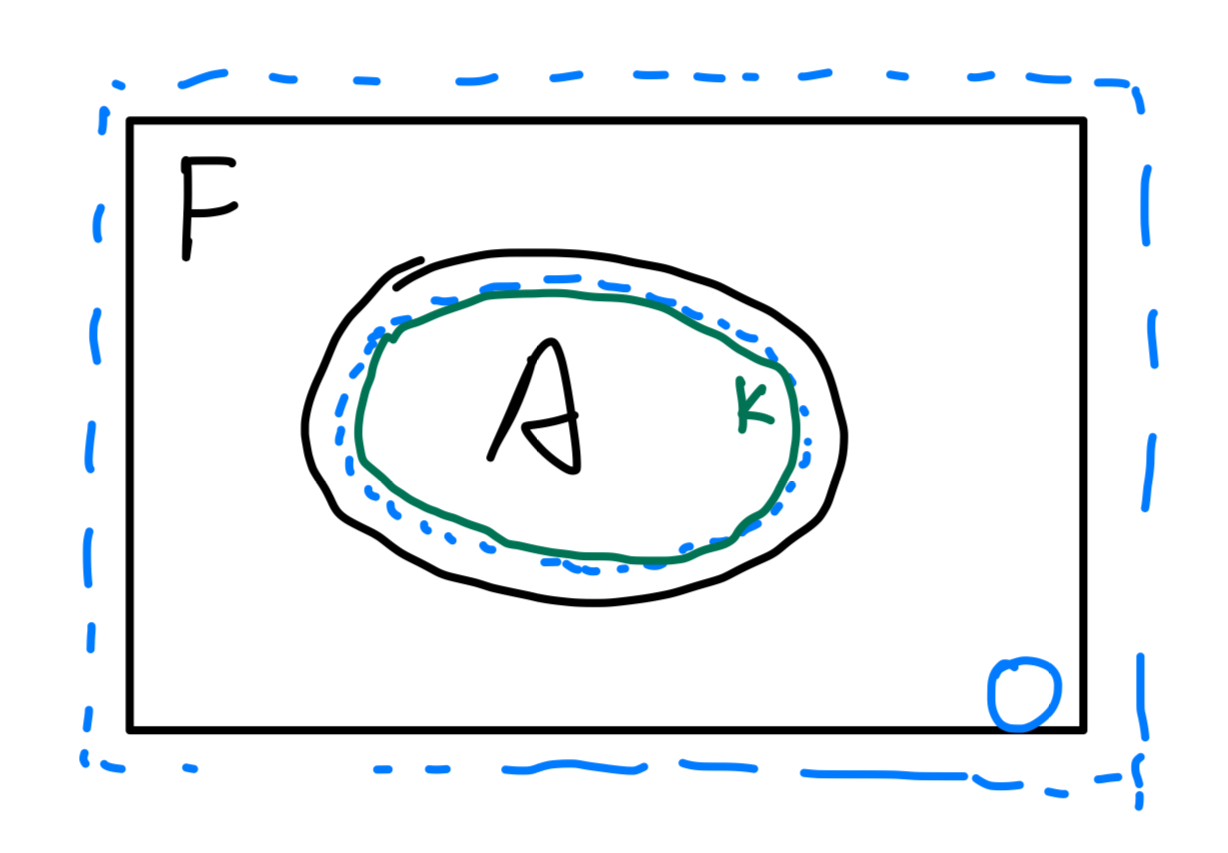
Figure 3.1: \(A\) bounded
- First suppose \(A\) bounded; consider compact \(F\supset A\),
then there is an open set \(G\supset F-A\) which \(\epsilon\)-approximates
\(F-A\), then \(K=A\cap O^c\) is a compact sub-\(\epsilon\) subset approximation
of \(A\).
- \(K\) must be compact, else \(F\subset K\cup O\) will not be compact.
- \(A\) unbounded: we can construct for each \(j\in \mathbb N\) an \(\epsilon\)-approximation of \(A_j = A\cap \overline{B_j(0)}\) with \(A_j\to A\implies \mu(A_j)\to \mu(A)\).
Theorem 3.2 (measurability by open cover approximation) \(A\subset \mathbb R^n\) is Lebesgue measurable iff \(\forall \epsilon>0\), there exists \(G\supset A\) such that \[ \mu_*(G - A) < \epsilon \]
Proof
Given \(A\) measurable, the result follows from open cover infimum proposition 3.2. Conversely, suppose \(A\subset \mathbb R^n\) satisfies the conditions in the theorem, then choose an \(\epsilon\)-cover \(G\supset A\). Note that \[ E\cap A^c = E\cap G^c + E\cap (G-A) \] Directly verify the Carathéodory criterion: we use the measurability of \(G\) and subadditivity \[\begin{align} \mu_*(E\cap A) + \mu_*(E\cap A^c) &= \mu_*(E\cap A) + \mu_*(E\cap A^c) \\ &\leq \mu_*(E\cap G) + \mu_*(E\cap G^c) + \mu_*(E\cap (G-A)) \\ &\leq \mu_*(E\cap G) + \mu_*(E\cap G^c) + \mu_*(G-A)_{< \epsilon} \\ &< \mu_*(E\cap G) + \mu_*(E\cap G^c) + \epsilon = \mu_*(E\cap G) + \epsilon \end{align}\]Theorem 3.3 (inner and outer regularity) \(A\subset \mathbb R^n\) is Lebesgue measurable iff \(\forall \epsilon>0\), there exists open \(G\), closed \(F\), with \(F\subset A\subset G\) such that \(\mu_*(G - F) < \epsilon\).
Proof: If \(A\) satisfies the theorem conditions, then \(\mu_*(G - A) \leq \mu_*(G - F)<\epsilon\) so \(A\) is measurable by theorem 3.2. Conversely, given \(A\) measurable, by theorem 3.2 choose \(\epsilon/2\)-covers of both \(A\) and \(A^c\).
Theorem 3.4 (measurability by Borel approximation) \(A\subset \mathbb R^n\) is Lebesgue measurable iff there exists Borel sets \(G, F\) with \(F\subset A\subset G\) such that \[ \mu(G - A) = \mu(A - F) = 0 \]
Proof: By theorem 3.3, construct for each \(k\in \mathbb N\) sets \(G_k, F_k\) which \(1/k\)-squeeze \(G\), then \(G=\bigcap G_k, F=\bigcup F_k\) proves the theorem.